Several reasons motivated us to bring this initiative to fruition!
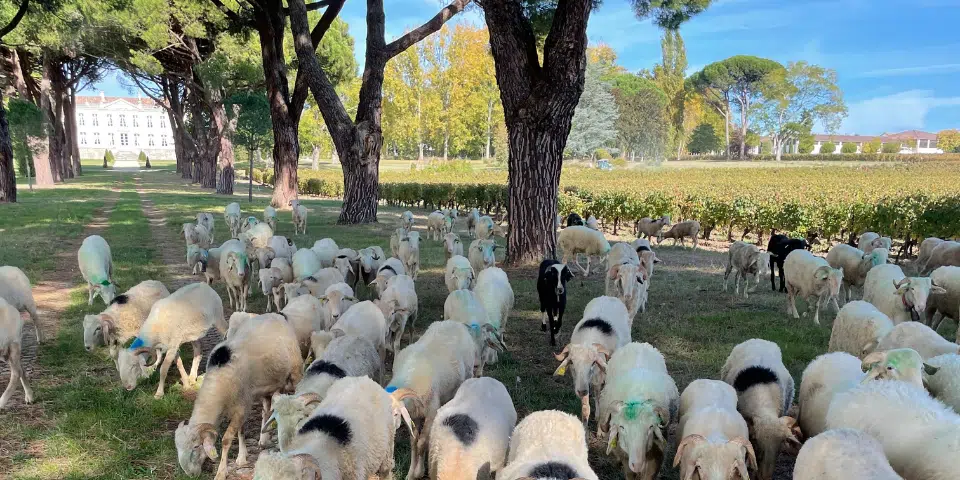
The shepherds need pasture during autumn and winter to meet the animals’ needs. Thanks to our working philosophy, no pesticides or chemical products such as herbicides are used, allowing us to provide this 100% natural and organic food source to the animals. In return, natural and uniform mowing throughout our vineyard will be performed, as the sheep will graze the cavaillon and around the vine stocks. In addition to this mowing, we will benefit from natural fertilization across all vineyard parcels.
This itinerant project will extend across our 70 hectares, promoting soil cultivation. Through their hooves, the sheep will help decompact the top layer of soil, thus performing this surface work.
With the aim of looking ever further ahead, we also take carbon footprint into consideration. The sheep will enable us not to purchase compost thanks to the natural fertilization, and we will produce our own hay and straw directly on the estate. All these actions help limit the use of vehicles and thereby reduce the carbon footprint.
The presence of the animals interacts directly with their entire environment. Each finds its place and works in symbiosis. Every action, every choice, every decision is designed to foster this harmony between fauna and flora. All these steps form this virtuous circle, promoting balance and the preservation of a fragile yet essential biodiversity!